Many centuries before the philanthropist Titus Salt built Salts Mill and the village of Saltaire, the Roman philosopher Titus Lucretius wrote his epic poem De Rerum Natura, commonly translated as “On the Nature of Things”. This influential piece of writing was based on ideas inherent to Epicurean natural philosophy, and advocated moderation, simplicity and community as the foundation for happiness. The village of Saltaire, with its houses, almshouses, shops, schools, infirmary, washhouses, and churches, built by the deeply religious Salt for the workforce of his mill, embodied many of the ideas posited by Lucretius, despite the extravagant size and scale of the mill and his industrial dynasty.
De Rerum Natura was an attempt to show through poetry that everything in nature can be explained by natural laws, without the need for the intervention of divine beings. In its six chapters, the work examined the principles of atomism, the nature of the mind and soul, explanations ofsensation and thought, and a variety of celestial and terrestrial phenomena. As artists and sculptors, the nature of things is our primary concern. We invariably work with objects and materials, exploring what they do when subjected to various processes; we observe how things behave when we build with them, deconstruct them, or juxtapose them with other things. Wework sometimes scientifically and sometimes intuitively, concerned with howthe results of our experiments stimulate sensation and thought in our audience.
This exhibition by The Yorkshire Sculptors Group takes place in an un-renovated part of Salts Mill where we are inevitably reminded of the nature of things: the paint peeling from surfaces demonstrating the pull of gravity and the effects of age, the quality of natural light on deeply textured surfaces, and our own scale in relation to this vast open space. As artists with widely differing interests and concerns we each respond tothis space and exhibition title in our own individual ways, whilst recognising that it is the nature of things which connects all of our work and practices.
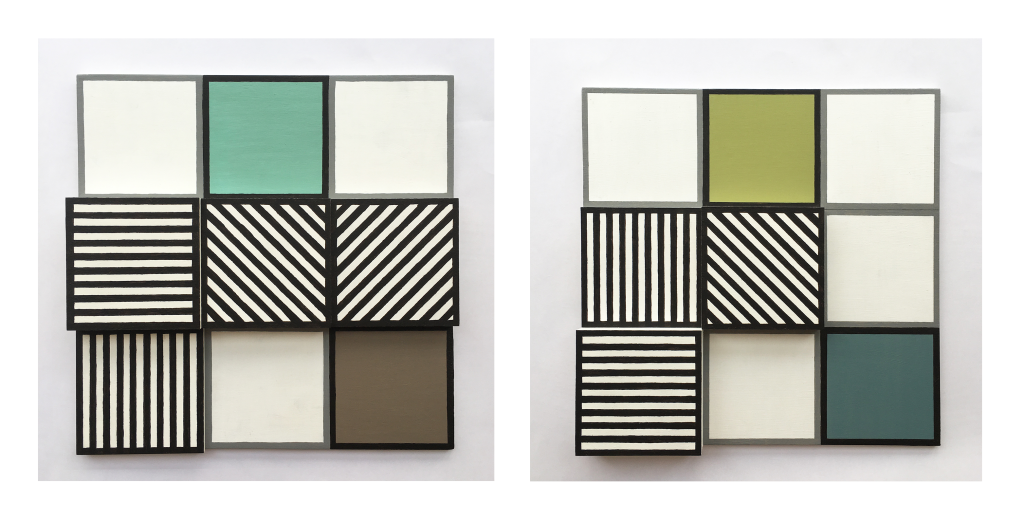
Image: (left) District 7, 3×3, Tile 1; 2020 [30x30cm] (right) District 7, 3×3, Tile 7; 2020 [30x30cm] by Patrick Ford